
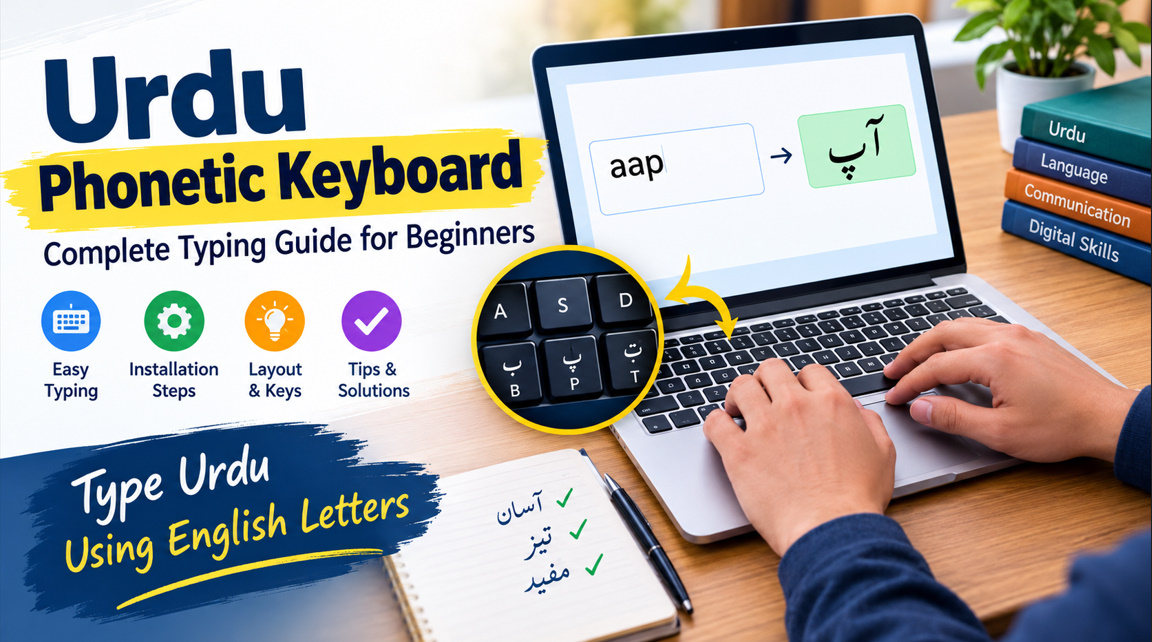
What Is an Urdu Phonetic Keyboard?
An Urdu phonetic keyboard is a typing tool that allows users to write Urdu words by pressing English keys that correspond to similar Urdu sounds. Instead of memorizing a traditional Urdu keyboard layout, beginners can type familiar Roman letters and produce Urdu script. This makes Urdu typing easier, faster, and more accessible.
The Urdu phonetic keyboard is useful for students, teachers, writers, bloggers, and everyday computer users. It supports Urdu content creation for documents, emails, social media posts, and educational assignments. By connecting English letters with Urdu sounds, this keyboard layout helps users become comfortable with Urdu typing without extensive keyboard training.
- Easy Urdu typing for beginners
- English-to-Urdu phonetic mapping
- Familiar QWERTY keyboard layout
- Support for Urdu script
- Useful for students and teachers
- Convenient for online communication
- Helpful for Urdu content writing
- Reduced need to memorize keys
How Does an Urdu Phonetic Keyboard Work?
An Urdu phonetic keyboard works by mapping English keyboard keys to Urdu letters according to their sounds. For example, pressing a key associated with the sound of b can produce the Urdu letter ب. The exact key mapping depends on the keyboard layout or software being used, so some letters may require different combinations.
When users type words using the phonetic layout, the software converts their keystrokes into Urdu characters. The resulting text appears in Urdu script, which reads from right to left. This process makes Urdu typing more intuitive for people who already understand English keyboard positions and can recognize common Urdu sounds.
- Uses familiar English keys
- Converts keystrokes into Urdu characters
- Follows phonetic sound patterns
- Supports right-to-left writing
- Offers convenient letter combinations
- Reduces traditional layout memorization
- Works with compatible typing software
- Helps users learn Urdu typing gradually
Benefits of Using an Urdu Phonetic Keyboard
One major benefit of an Urdu phonetic keyboard is convenience. Users can type Urdu without learning every key position on a conventional Urdu keyboard. This is particularly helpful for beginners who regularly write Urdu assignments, prepare office documents, communicate online, or create educational materials in their native language.
Another advantage is improved productivity. Once users understand the key combinations, they can type frequently used Urdu words more confidently. A phonetic layout also makes switching between English and Urdu easier in many applications. However, typing speed and accuracy depend on practice, the selected keyboard layout, and familiarity with Urdu spelling.
- Beginner-friendly typing method
- Faster learning curve
- Convenient language switching
- Better access to Urdu writing
- Useful for academic assignments
- Supports digital communication
- Helpful for multilingual users
- Suitable for everyday writing tasks
How to Install an Urdu Phonetic Keyboard on Windows
Windows users can add Urdu through the operating system’s language settings. Open Settings, select the language or time-and-language section, and locate the option to add a language. Search for Urdu, follow the installation prompts, and check the available keyboard layouts. The exact menu names can vary depending on the Windows version.
After adding Urdu, select the installed keyboard layout from the taskbar language indicator or use the configured keyboard shortcut to switch languages. If a phonetic layout is not available by default, you may need a compatible Urdu phonetic keyboard layout or typing tool. Always confirm the layout before beginning a lengthy document.
- Open Windows Settings
- Find language preferences
- Add the Urdu language
- Review available keyboard layouts
- Select a compatible phonetic layout
- Switch languages from the taskbar
- Test several Urdu characters
- Check right-to-left text display
How to Use an Urdu Phonetic Keyboard on Mobile
Smartphones also support Urdu typing through compatible multilingual keyboard applications and built-in language settings. Users can open their keyboard settings, add Urdu as an input language, and choose an available layout. Depending on the keyboard, phonetic typing may be offered directly or through a transliteration feature that converts Roman Urdu into Urdu script.
Mobile Urdu typing is particularly useful for messaging, social media captions, comments, and short documents. Users should check whether their keyboard offers a phonetic layout or Roman Urdu transliteration because these are not always the same feature. Once enabled, switching between English and Urdu generally takes only a tap on the language button.
- Open your phone’s keyboard settings
- Add Urdu as an input language
- Check available typing layouts
- Enable phonetic input if supported
- Explore Roman Urdu transliteration
- Switch languages when needed
- Test common words and sentences
- Review spelling before sending messages
Urdu Phonetic Keyboard Typing Examples
Learning through examples is one of the simplest ways to understand an Urdu phonetic keyboard. Many layouts connect familiar English sounds with corresponding Urdu letters. For instance, the sound b is commonly associated with ب, while m is associated with م. These examples demonstrate the principle, although complete word mappings vary across layouts.
Beginners should practice frequently used Urdu words and short sentences before moving to longer paragraphs. Start with greetings, everyday expressions, and simple phrases. Check the output carefully because Urdu contains letters with similar sounds, and a phonetic keyboard may not automatically determine the intended spelling of every word.
- ب — commonly associated with the b sound
- م — commonly associated with the m sound
- ن — commonly associated with the n sound
- پ — commonly associated with the p sound
- Urdu greetings and expressions
- Everyday vocabulary practice
- Short sentence composition
- Spelling and character recognition
Urdu Phonetic Keyboard vs. Traditional Urdu Keyboard
An Urdu phonetic keyboard and a traditional Urdu keyboard both allow users to write in Urdu, but their key arrangements differ. A phonetic layout associates keys with sounds familiar to English keyboard users. A traditional layout follows a predefined Urdu keyboard arrangement, which users generally learn through practice and memorization.
The best choice depends on your experience and typing requirements. Beginners who already use an English QWERTY keyboard may find phonetic typing easier to learn. Experienced Urdu typists may prefer a traditional layout because they already know its key positions. Both options can produce Urdu text when correctly configured and supported by the application.
- Phonetic layouts focus on sound
- Traditional layouts use fixed key positions
- Phonetic typing may feel intuitive
- Traditional typing rewards layout familiarity
- Both support Urdu script
- Software determines available features
- Accuracy improves with regular practice
- Personal preference guides the choice
Tips for Improving Urdu Phonetic Typing Speed and Accuracy
Improving Urdu phonetic typing requires consistent practice and attention to spelling. Begin with short words, then progress to sentences and longer paragraphs. Learn the specific key combinations used by your chosen layout, especially for Urdu letters that have similar sounds. Reviewing your typed text helps identify repeated errors and builds familiarity with Urdu script.
For better results, use a consistent keyboard layout across your regular writing applications whenever possible. Confirm that Urdu text displays correctly, particularly when combining Urdu with English words, numbers, or punctuation. If the output differs from your expectations, check the selected input language and layout before changing your typing habits.
- Practice for a few minutes daily
- Learn common key combinations
- Type short Urdu sentences
- Review spelling and punctuation
- Use one familiar layout consistently
- Practice difficult Urdu letters
- Check right-to-left text direction
- Increase typing length gradually